FEIE 2026
Foreign Earned Income Exclusion 2026: Everything UK Expats Need to Know
The Foreign Earned Income Exclusion lets US expats exclude up to $132,900 of earned income for 2026. Here is how the FEIE works, who qualifies, and how to claim it from the UK.
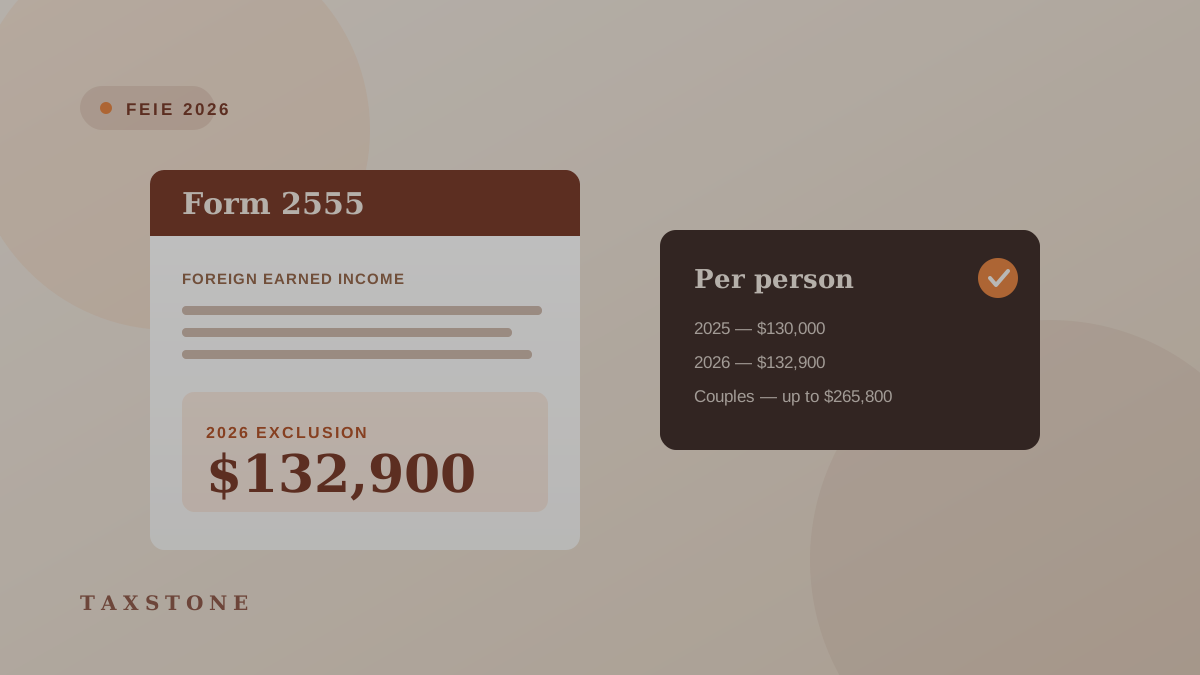
The Foreign Earned Income Exclusion (FEIE) lets qualifying US citizens and Green Card holders abroad exclude a chunk of their foreign salary from US tax. For the 2026 tax year the maximum exclusion is $132,900 per person, up from $130,000 for 2025. If you live and work in the UK, the FEIE is one of the two main tools that stop you being taxed twice — and here is exactly how it works.
How much is the FEIE for 2025 and 2026?
- Tax year 2026 (returns filed in 2027): up to $132,900 of earned income excluded per person.
- Tax year 2025 (returns filed in 2026): up to $130,000 per person.
- Married couples who both work and both qualify can each claim it — up to $265,800 combined for 2026.
- Foreign housing exclusion base limit: $39,870 for 2026 ($39,000 for 2025), on top of the FEIE.
Who qualifies for the FEIE?
To claim the exclusion you must have foreign earned income, a tax home in a foreign country, and meet one of two residency tests:
- Bona Fide Residence Test — you are a genuine resident of the UK for an uninterrupted period that includes a full tax year. Best for settled, long-term residents.
- Physical Presence Test — you are physically present in a foreign country for at least 330 full days in any rolling 12-month period. Best for newer arrivals or frequent travellers.
How to claim it: Form 2555
You claim the FEIE by attaching Form 2555 to your Form 1040. The form establishes which residency test you meet, calculates your excludable amount, and applies the foreign housing exclusion if relevant. Once you elect the FEIE it generally stays in effect each year until you revoke it — and revoking it locks you out of re-electing for five years without IRS permission, so the choice matters. If you are new to US filing from the UK, start with our guide to how US tax returns work for Americans in the UK.
FEIE vs the Foreign Tax Credit — which is better in the UK?
This is the single most important decision for a US expat in Britain. The FEIE removes income from US tax entirely; the Foreign Tax Credit (Form 1116) instead gives you a dollar-for-dollar credit for UK tax already paid.
Because UK income-tax rates are often higher than US rates, the Foreign Tax Credit frequently wipes out the US bill on its own — and, unlike the FEIE, it does not disqualify you from claiming the refundable Child Tax Credit or from contributing to a US IRA based on excluded income. For many UK-resident Americans the Foreign Tax Credit alone is the better answer; for those in lower-tax situations or with income above the FTC's reach, the FEIE or a combination wins. Choosing the right US specialist makes this call easier — see what to look for in a US tax specialist in the UK.
The foreign housing exclusion
On top of the FEIE, the foreign housing exclusion lets you exclude certain housing costs above a base amount. For 2026 the base housing amount is $39,870, and higher-cost locations (London is on the IRS's high-cost list in most years) get an increased cap. For expats with significant rent in London, this can meaningfully increase the total excluded.
Common FEIE mistakes we see
- Assuming the FEIE means you do not have to file — you must file Form 1040 with Form 2555 to claim it; it is never automatic.
- Using the FEIE and then losing the refundable Child Tax Credit that the Foreign Tax Credit would have preserved.
- Miscounting days under the Physical Presence Test (the 330 days must be full days in a foreign country).
- Trying to exclude investment or rental income — the FEIE only covers earned income.
- Revoking the election casually and being locked out for five years.
Does the FEIE eliminate all your US tax?
Not always. It excludes earned income up to the cap, but income above $132,900 (2026), and all unearned income, remains in scope — and is taxed using the stacking rule, which applies the rate that would have applied without the exclusion. You may still owe US tax, still need the Foreign Tax Credit for the remainder, and still have FBAR and FATCA reporting on your UK accounts regardless of the FEIE.
Frequently asked questions
How much is the Foreign Earned Income Exclusion for 2026?
For the 2026 tax year, the maximum Foreign Earned Income Exclusion is $132,900 per qualifying person, up from $130,000 for the 2025 tax year. Married couples who both work abroad and both qualify can each claim it, excluding up to $265,800 combined for 2026. A separate foreign housing exclusion, with a 2026 base amount of $39,870, can apply on top.
Do I still have to file a US tax return if the FEIE covers all my income?
Yes. The Foreign Earned Income Exclusion is not automatic — you only get it by filing Form 1040 with Form 2555 attached and electing the exclusion. If you do not file, you do not get the exclusion, and the IRS can later deny it. You also remain responsible for FBAR and FATCA reporting on your UK accounts regardless of the FEIE.
Is the FEIE or the Foreign Tax Credit better for Americans in the UK?
It depends on your income and goals. Because UK tax rates are often higher than US rates, the Foreign Tax Credit (Form 1116) frequently eliminates your US bill on its own and, unlike the FEIE, preserves the refundable Child Tax Credit and IRA-contribution room. The FEIE can be better in lower-tax situations or where you have little UK tax to credit. Many filers benefit from modelling both each year rather than defaulting to one.
Can both spouses claim the Foreign Earned Income Exclusion?
Yes. If a married couple both work abroad and each independently meets the bona fide residence or physical presence test, each spouse can claim the FEIE on their own foreign earned income. For 2026 that means a combined exclusion of up to $265,800.
Does the FEIE apply to UK rental income or investments?
No. The Foreign Earned Income Exclusion only applies to earned income — salary, wages and self-employment earnings. UK rental income, dividends, interest, pensions and capital gains are not eligible. Those are generally handled with the Foreign Tax Credit for any UK tax paid on them.