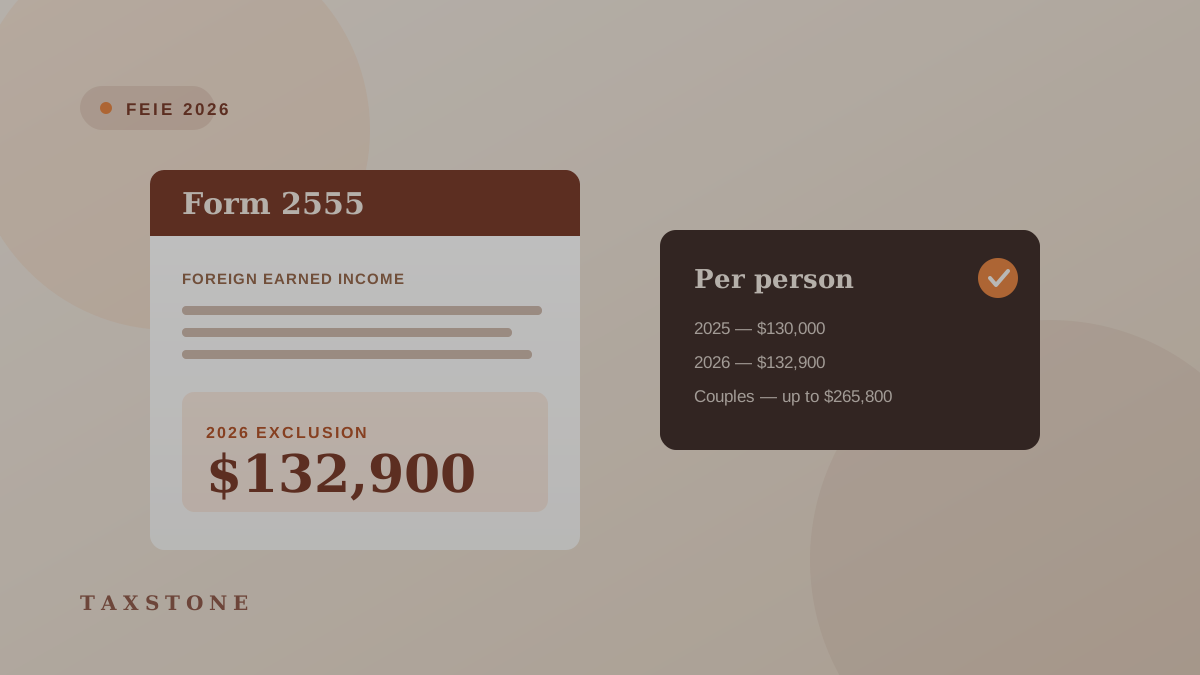
The **foreign housing exclusion** lets a US citizen or Green Card holder working abroad exclude a slice of their qualifying housing costs from US taxable income — the amount by which those costs exceed a base figure, and up to a location-specific ceiling. It sits on top of the Foreign Earned Income Exclusion, so for 2026 you can shelter the first $132,900 of foreign earnings with the FEIE and then exclude qualifying housing spend above $21,264 as well. For a US citizen renting in London, where the 2026 housing ceiling is $68,600, that second exclusion is worth up to roughly $47,336 of extra income kept out of the US tax net.
It is one of the most under-claimed reliefs for Americans in high-rent cities, and one of the easiest to get wrong. This guide sets out the 2026 numbers, the mechanics of the base amount and the ceiling, who can and cannot use it, how the deduction version works for the self-employed, and the errors that quietly cost expats thousands each filing season.
What the foreign housing exclusion actually is
The exclusion is authorised by section 911(c) of the Internal Revenue Code, the same provision that gives you the FEIE. The logic is that the cost of housing yourself abroad is often far higher than at home, so Congress allows you to exclude housing costs above a baseline — the portion the law assumes you would have paid anyway — subject to a cap.
You claim it on the same form as the FEIE, Form 2555, in Parts VI and VII. It is not automatic: if you file only Form 1116 for the foreign tax credit, you get no housing exclusion, and if you leave Parts VI–IX of Form 2555 blank, the IRS will not compute it for you. You have to elect it, and once elected it stays in force until you revoke it.
Crucially, the exclusion reduces income that would otherwise be taxed. It is not a credit and not a refund — it lowers the number your US tax is calculated on.
The 2026 numbers: base amount, standard cap and the London ceiling
Three figures drive the calculation, and all three move with the FEIE each year. For 2026 the FEIE is $132,900, confirmed in IRS Revenue Procedure 2025-32.
The base housing amount is 16% of the FEIE — $21,264 for 2026. This is the floor: only housing costs above it count. The standard housing limitation is 30% of the FEIE — $39,870 for 2026 — which caps the housing expenses you may take into account before subtracting the base. So on the standard cap, the largest exclusion is $39,870 minus $21,264, or $18,606.
But the IRS publishes higher limits for expensive cities each year. Under IRS Notice 2026-25, effective for tax years beginning on or after 1 January 2026, London has a housing expense limit of $68,600. Subtract the $21,264 base and a Londoner can exclude up to about $47,336 of qualifying housing costs — more than two and a half times the standard figure.
How the foreign housing exclusion is calculated, step by step
Start with your qualified housing expenses for the year — more on what counts below. Cap them at the applicable limit for your location ($39,870 standard, or the city figure such as $68,600 for London). Then subtract the base amount of $21,264. Whatever is left is your foreign housing exclusion, provided you have enough foreign earned income to support it.
A worked example: an American renting in London pays £3,200 a month in rent plus £250 in utilities, roughly $54,000 for the year at prevailing rates. That is below London's $68,600 ceiling, so all $54,000 counts. Subtract the $21,264 base and the housing exclusion is $32,736. Combined with the $132,900 FEIE, this expat shelters $165,636 of income before a dollar of US tax is calculated.
The ordering rule that trips people up
The housing exclusion is applied before the FEIE, not after. On Form 2555 you compute the housing exclusion first, and the FEIE is then limited to your foreign earned income minus the housing amount already excluded. The two together can never exceed your total foreign earned income.
This matters at the margins. If you earn exactly $150,000 abroad and claim a $47,000 housing exclusion, your FEIE is capped at $103,000 rather than the full $132,900 — because $47,000 plus $132,900 would exceed your earnings. For most people in high-cost cities the combined shelter is still larger than the FEIE alone, but the interaction is why you cannot simply add the two headline numbers together and assume that is your total relief. Modelling it properly is exactly what our US foreign housing exclusion calculator is built to do.
Who qualifies for the foreign housing exclusion
You qualify if you meet the same tests as the FEIE: you must have a tax home in a foreign country and satisfy either the bona fide residence test (a full, uninterrupted tax year as a resident of a foreign country) or the physical presence test (330 full days in a foreign country during any 12-month period). Americans settled in the UK almost always meet the bona fide residence test once they have been resident across a complete US tax year.
The expenses must also be paid from foreign earned income — salary, wages or self-employment income for services performed abroad. Housing paid for out of US-source income, investment income or pension income does not qualify. And the exclusion applies to employees; if you are self-employed you use the parallel foreign housing deduction instead, covered below.
What counts as qualified housing expenses
Qualified expenses are the reasonable costs of housing yourself, your spouse and your dependants abroad. They include rent, the fair rental value of employer-provided housing, utilities other than telephone, property insurance, non-refundable occupancy deposits, residential parking, rental of furniture and accessories, and household repairs.
They do not include the cost of buying a property, mortgage principal or capital improvements, domestic staff wages, deductible interest and taxes claimed elsewhere, the cost of furniture you purchase, television subscriptions, or anything lavish beyond what is reasonable. For homeowners, note that mortgage interest and property taxes are excluded here because they are deductible on Schedule A — you cannot double-count them.
- Included: rent, utilities (not phone), property and contents insurance, residential parking, furniture rental, occupancy deposits, household repairs.
- Excluded: purchase price, mortgage principal or interest, capital improvements, domestic help, purchased furniture, TV licence and subscriptions, anything extravagant.
- Employer-provided accommodation counts at its fair rental value and is included in your income first, then excluded here.
The self-employed version: the foreign housing deduction
If your qualifying income is self-employment income, you cannot use the housing exclusion — you take a foreign housing deduction instead. It uses the same base amount and the same location ceiling, but instead of excluding the amount it deducts it in arriving at adjusted gross income, and the deduction is limited to your foreign earned income after the FEIE.
The practical difference is that the deduction cannot create a loss and any excess can carry over only to the following year. Americans running a UK limited company are usually employees of their own company and use the exclusion; sole traders and partners in a UK partnership use the deduction. Getting the classification right is the difference between a clean claim and an IRS query — if you are unsure which applies, contact us before you file.
Why the housing exclusion still matters when the FEIE zeroes your tax
A common assumption is that once the FEIE and the standard deduction wipe out your US tax, the housing exclusion is irrelevant. Often it is not. If your foreign earnings exceed the FEIE — which is easy in London at senior salary levels — the housing exclusion shelters income that would otherwise sit above the FEIE ceiling and be taxed at your marginal US rate.
It also interacts with the foreign tax credit. Income you exclude cannot also generate a foreign tax credit, so the choice between excluding housing costs and claiming a credit for the UK tax on that income is a genuine planning decision. For high earners paying UK tax at 40% or 45%, the foreign tax credit frequently eliminates the US liability on its own, and stacking a housing exclusion on top can waste UK tax that would otherwise carry forward as excess credit. We walk through the trade-off in foreign tax credit versus the FEIE.
The stacking rule: your excluded income is not taxed at 0%
Since 2006, excluded foreign income does not fall out of the rate calculation. The FEIE and housing exclusion are subtracted, but the tax on your remaining income is computed as if the excluded amount were still in the stack — the so-called stacking or exclusion tax rule on the Foreign Earned Income Tax Worksheet.
In plain terms: if you exclude $165,000 and have $40,000 of income left over, that $40,000 is taxed at the rates that would apply to income between $165,000 and $205,000, not at the rates for the first $40,000. It rarely changes the answer for people whose UK tax generates ample foreign tax credits, but it is why the arithmetic on a high-income return is never as simple as multiplying leftover income by the bottom bracket.
Married couples: two exclusions, one household
Where both spouses work abroad and both have foreign earned income, each can claim their own FEIE, but the housing exclusion is shared per household. If you live together, only one spouse claims the housing amount for the shared home; you cannot both exclude the same rent. If you maintain separate foreign households — genuinely separate residences, not merely separate finances — each can claim on their own dwelling.
The base amount and the ceiling are per person by qualifying days, so a couple filing jointly should generally assign the housing exclusion to whichever spouse has the foreign earned income to support it, then use the FEIE and foreign tax credits to mop up the rest.
Part-year and the qualifying-days proration
The base amount and the housing limit are both prorated by the number of days in the year that fall within your qualifying period. Move to London on 1 July and qualify for 184 days, and your base amount and London ceiling are each multiplied by 184/365. This is the single most common source of over-claims: expats apply the full-year figures to a part-year of qualification and overstate the exclusion.
The physical presence test can straddle two tax years, and the proration follows the qualifying period rather than the calendar year, so first-year and final-year returns need care. When you move mid-year, the Foreign Earned Income Exclusion for 2026 explains how the same day-counting drives both reliefs.
Common mistakes that cost Americans money
- Forgetting the exclusion entirely because the FEIE already reduced tax to zero, while income above the FEIE was still taxed.
- Applying the full-year base and ceiling to a part-year of qualification.
- Using the standard $39,870 cap when a higher city limit such as London's $68,600 applies.
- Double-counting mortgage interest and property taxes that are already on Schedule A.
- Claiming housing costs funded by US-source or investment income rather than foreign earned income.
- Stacking a housing exclusion on top of foreign tax credits that already eliminate the US tax, wasting UK credit that could have carried forward.
How TaxStone approaches the housing exclusion
For a typical TaxStone client in London, we run the numbers three ways — FEIE plus housing exclusion, FEIE plus foreign tax credit, and foreign tax credit alone — and file whichever produces the lowest combined US and UK exposure across the years, not just the current one. The right answer for a $150,000 earner paying UK higher-rate tax is frequently different from the right answer for a $250,000 earner or a self-employed consultant.
Because the exclusion is an election that carries forward and can only be revoked deliberately, the decision has a multi-year tail: revoke it and you generally cannot re-elect for five years without IRS consent. That is why we model it rather than defaulting to it. Book a free consultation and we will map the most efficient combination for your situation before you file: /get-started.
The short version
The foreign housing exclusion is a genuine, sizeable relief that most Americans in high-rent cities under-use. For 2026 it shelters qualifying housing costs above $21,264, up to $39,870 as standard or $68,600 in London, and it stacks on top of the $132,900 FEIE. Claim it on Form 2555, prorate it for part-years, and never double-count costs deducted elsewhere.
The one caveat worth repeating: it is not always the best option. Against substantial UK tax, the foreign tax credit often wins, and the exclusion can waste credits you would otherwise keep. Run both. If you would like that modelled properly, contact us and we will show you the numbers side by side.