UK Home · US CGT
Selling Your UK Home: US Capital Gains Tax for Americans Abroad
Selling a UK home can trigger US capital gains tax even when the UK charges nothing. Here is how the $250k/$500k exclusion, the mortgage currency trap and the foreign tax credit work.
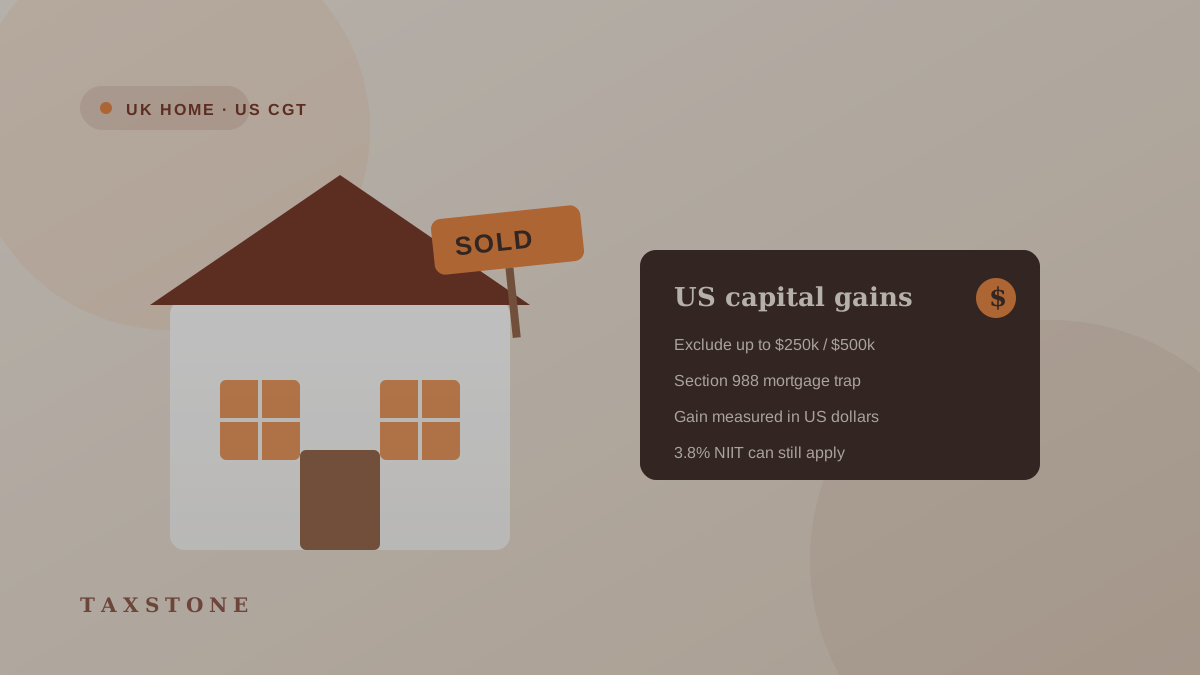
If you are an American selling your home in the UK, the United States can tax the gain — even in the common situation where the UK charges you no Capital Gains Tax at all because of Private Residence Relief. As a US citizen or Green Card holder you are taxed on worldwide gains, so the sale goes on your US return wherever the property sits. You may be able to exclude up to $250,000 of gain ($500,000 if married filing jointly) under Section 121, but two things catch UK-based Americans out: the gain is measured in US dollars at each date (so exchange-rate moves create extra gain), and a separate currency gain on repaying your UK mortgage can be taxable as ordinary income even when the home sale itself is fully excluded. This guide walks through the whole calculation.
Does the US tax the sale of my UK home?
Yes. The US taxes US persons on their worldwide capital gains, so selling a UK main residence is a reportable event on your US return regardless of how the UK treats it. The US-UK tax treaty generally gives the UK the first right to tax gains on UK real estate, with the US then giving a foreign tax credit for any UK tax paid. The catch is that the UK usually charges little or no Capital Gains Tax on the sale of your only or main home because of Private Residence Relief — so there may be no UK tax to credit against the US bill. That is the structural reason a sale that costs nothing in Britain can still cost you in America.
The Section 121 exclusion: $250,000 / $500,000
The main US relief for selling a home is the Section 121 exclusion. If the property was your main residence, you can exclude up to $250,000 of gain if you are single, or up to $500,000 if you are married filing jointly. To qualify you must meet the ownership and use tests:
- Ownership test: you owned the home for at least 24 months out of the 5 years ending on the sale date.
- Use test: you lived in it as your main home for at least 24 months out of those same 5 years.
- For married filing jointly: only one spouse needs to meet the ownership test, but both must meet the use test to claim the full $500,000.
- You generally cannot use the full exclusion more than once in any two-year period.
How the US gain is actually calculated
Here is where UK sellers get surprised. The US gain is not simply the sterling sale price minus the sterling purchase price converted at today's rate. You must translate the purchase price (your cost basis) into US dollars using the exchange rate on the date you bought, and translate the sale proceeds into dollars using the rate on the date you sold. If the pound strengthened against the dollar over your ownership period, that currency movement inflates your dollar gain — you can show a healthy gain in dollars even if the sterling price barely moved.
Capital improvements (a loft conversion, an extension) add to your basis and are each translated at the rate on the date you paid for them. Selling costs such as estate-agent fees and legal fees reduce the gain. Keeping clean records of dates and sterling amounts is essential, because every figure has to be converted at its own historical rate.
The Section 988 mortgage currency trap
This is the trap almost no one expects. If you had a UK mortgage in pounds, repaying or refinancing it is treated as a separate foreign-currency transaction under Section 988 of the tax code. If the pound weakened against the dollar between taking out the mortgage and repaying it, you can have a phantom currency gain — because in dollar terms you repaid less than you borrowed. That gain is taxed as ordinary income at your normal income-tax rates, and crucially the Section 121 home-sale exclusion does not shelter it.
So you can be in the strange position where the gain on the house itself is fully covered by your $250,000 / $500,000 exclusion, yet you still owe US tax on a currency gain from the mortgage. The Section 988 gain is reported as other income on Schedule 1, separately from the property gain on Form 8949 and Schedule D. A currency loss on the mortgage, by contrast, is a personal loss and is generally not deductible — an asymmetry that makes the rule feel especially unfair.
The UK side: Private Residence Relief
On a genuine only-or-main home, the UK generally gives full Private Residence Relief, so most homeowners pay little or no UK Capital Gains Tax on a sale. Relief can be restricted if you let the property out, used part of it exclusively for business, or had periods of absence beyond those the rules allow. The key point for an American is counter-intuitive: the more effectively UK relief removes your UK tax, the less foreign tax credit you have to offset the US gain — so full UK relief can actually leave you with a larger net US bill than if you had paid some UK tax.
US capital gains rates and the 3.8% NIIT
Where US gain exceeds your exclusion, it is normally a long-term capital gain (assuming you owned the home more than a year), taxed at 0%, 15% or 20% depending on your total income for the year. On top of that, the 3.8% Net Investment Income Tax (NIIT) can apply, and the NIIT is a particular problem for expats because no foreign tax credit can be used against it — it is a separate charge.
- Long-term capital gains rates for 2025: 0% up to $48,350 taxable income (single) / $96,700 (married filing jointly); 15% above that; 20% above $533,400 (single) / $600,050 (MFJ).
- NIIT: an extra 3.8% once modified AGI exceeds $200,000 (single) or $250,000 (married filing jointly).
- The NIIT cannot be reduced by the foreign tax credit, so it can apply even where UK tax covered your regular US tax.
- Currency (Section 988) gain on a mortgage is taxed at ordinary rates, not the lower capital gains rates.
Partial exclusion if you do not meet the full test
If you fail the two-year ownership-and-use test because of a specific change in circumstances, you may still get a reduced exclusion. The IRS allows a partial Section 121 exclusion where the sale is due to a change in place of employment, health reasons, or certain unforeseen circumstances. The reduced exclusion is prorated based on the time you did meet the tests — useful for Americans who relocate back to the US, or move within the UK for a new job, before hitting the full two years.
How to report the sale on your US return
- Report the property gain or loss on Form 8949 and carry the total to Schedule D.
- Apply the Section 121 exclusion on Form 8949 using the prescribed exclusion code.
- Report any Section 988 mortgage currency gain as other income on Schedule 1.
- Claim a foreign tax credit on Form 1116 for any UK CGT actually paid on the sale.
- Keep a full record of purchase, improvement and sale dates with the sterling amounts and the exchange rate used for each.
Planning ahead before you sell
Because the US and UK reliefs do not line up, timing and structure matter. Selling in a year when your other income is low can keep more of the gain in the 0% or 15% band and below the NIIT threshold. Married couples should check that both spouses meet the use test to unlock the full $500,000 exclusion. And if you are weighing whether to sell before or after a move back to the US, the residency timing can change both the UK relief and the US credit position. These decisions are far easier with a specialist who runs both calculations together.