FBAR vs FATCA
FBAR vs FATCA: A Plain-English Guide for Americans in the UK
FBAR and FATCA are two different US foreign-account filings — and most Americans in the UK have to do both. Here is the plain-English difference, the thresholds, and what counts.
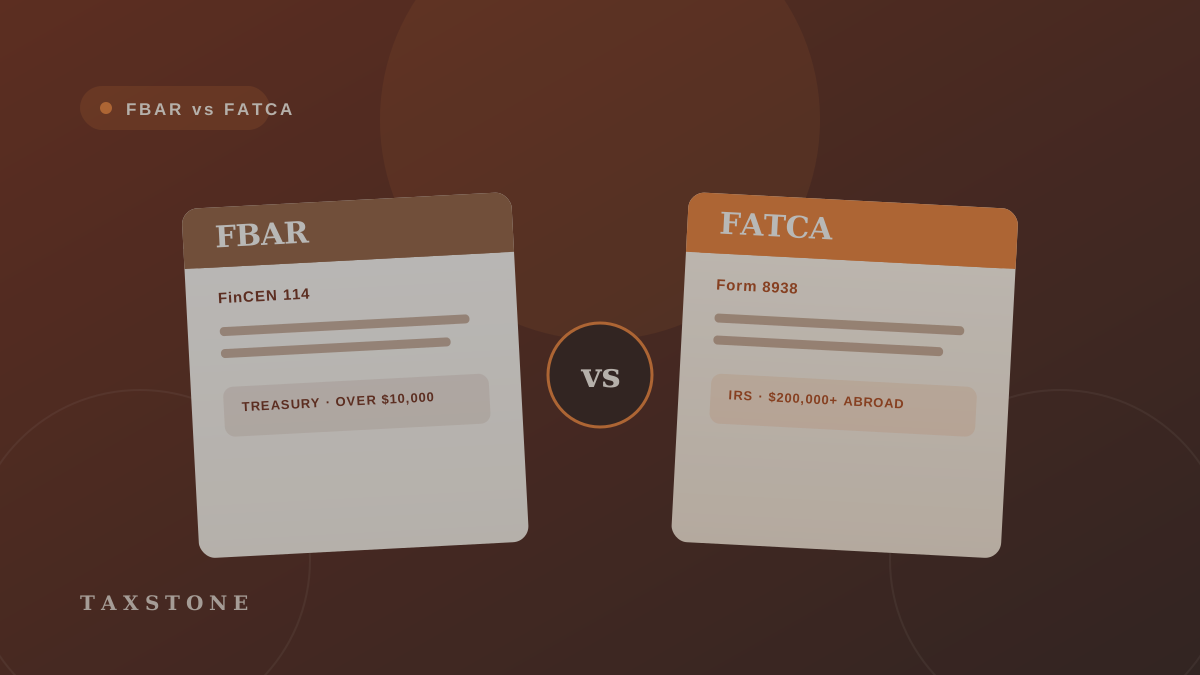
The simplest way to tell them apart: the FBAR (FinCEN Form 114) is filed with the US Treasury to report your foreign bank accounts, while FATCA (Form 8938) is filed with the IRS as part of your tax return to report a broader set of foreign financial assets. They overlap, they have different thresholds, and most Americans living in the UK end up filing both. Here is the plain-English version.
FBAR vs FATCA: the one-line difference
FBAR reports foreign accounts to FinCEN (the Treasury's financial-crimes unit); FATCA reports foreign financial assets to the IRS with your 1040. Same goal — stopping hidden offshore money — but two separate filings, two separate thresholds, and two separate sets of penalties.
What is the FBAR (FinCEN 114)?
The FBAR is the Report of Foreign Bank and Financial Accounts. You must file it if you are a US person and the combined value of all your non-US financial accounts exceeded $10,000 at any point during the year — even for a single day. It is e-filed separately through the FinCEN BSA E-Filing System, not attached to your tax return. For a deeper walkthrough, see our full FBAR guide.
- Threshold: $10,000 aggregate across all foreign accounts, at any moment in the year.
- Filed with: FinCEN (US Treasury), via the BSA E-Filing System.
- Deadline: 15 April, with an automatic extension to 15 October — no form required.
- It is an information report only — filing it does not create any tax.
What is FATCA (Form 8938)?
FATCA — the Foreign Account Tax Compliance Act — requires Form 8938, the Statement of Specified Foreign Financial Assets, to be filed with your Form 1040. It captures a wider net than the FBAR: not just accounts, but also foreign stocks, certain pensions, and interests in foreign entities. The thresholds are much higher and depend on your filing status and whether you live abroad — the IRS sets out the Form 8938 thresholds in detail. Many UK funds and Stocks & Shares ISAs reported here are also caught by the PFIC rules.
- Threshold (living in the UK): more than $200,000 on the last day of the year, or $300,000 at any time — single filers.
- Threshold (married filing jointly, abroad): $400,000 year-end, or $600,000 at any time.
- Filed with: the IRS, attached to your annual tax return.
- Covers: foreign accounts plus other specified financial assets (foreign shares, funds, some pensions).
FBAR vs FATCA, side by side
- Who runs it: FBAR → FinCEN / Treasury. FATCA → IRS.
- Where it goes: FBAR → filed on its own. FATCA → attached to Form 1040.
- Threshold: FBAR → $10,000. FATCA → $200,000+ (single, abroad).
- Scope: FBAR → accounts only. FATCA → accounts plus other financial assets.
- Penalty for non-filing: FBAR → up to $10,000+ per account (non-willful). FATCA → from $10,000, rising with continued failure.
Which UK accounts and assets count?
For a US person in the UK, far more counts than people expect. The same UK account can appear on both the FBAR and Form 8938.
- UK current, savings and joint bank accounts.
- Cash ISAs and Stocks & Shares ISAs (the IRS ignores the ISA's tax-free status).
- Workplace pensions and SIPPs — usually FBAR-reportable, and often Form 8938 too.
- UK investment and brokerage accounts (Hargreaves Lansdown, AJ Bell, etc.).
- Premium Bonds and other National Savings products.
- Accounts where you only have signature authority (FBAR) — e.g. a UK employer or relative's account.
Do most Americans in the UK file both?
Yes — very often. The FBAR's $10,000 trigger is so low that almost anyone with a UK salary paid into a current account crosses it. Form 8938 kicks in only at much higher asset levels, but once you add a pension pot, an ISA and some savings together, plenty of long-term UK residents pass that line too. When both apply, you file both; one never replaces the other.
What if you are behind on either one?
Missing FBARs and 8938s is common and usually fixable without penalties, provided the failure was non-willful. The IRS Streamlined Foreign Offshore Procedures let you file the last 3 tax returns (with Form 8938) and 6 years of FBARs penalty-free. If you owed no US tax, the Delinquent FBAR Submission Procedures can also let you file late FBARs without penalty.
Frequently asked questions
Do I have to file both FBAR and FATCA?
Often, yes. They are separate filings with different thresholds, so one does not replace the other. If your combined foreign accounts topped $10,000 at any point in the year you must file the FBAR (FinCEN 114). If your specified foreign financial assets also exceed the higher FATCA threshold — $200,000 at year-end for a single filer living abroad, or $400,000 if married filing jointly — you must additionally file Form 8938 with your tax return. Many long-term US residents of the UK end up filing both.
What is the FBAR filing threshold?
$10,000. You must file an FBAR if the aggregate value of all your non-US financial accounts exceeded $10,000 at any single moment during the calendar year. It is the combined total across every account, not a per-account figure, and even one day above the line triggers the requirement.
What is the Form 8938 (FATCA) threshold for Americans in the UK?
For US taxpayers living abroad, Form 8938 is required if your specified foreign financial assets exceed $200,000 on the last day of the tax year, or $300,000 at any time during the year, for single filers. For married couples filing jointly and living abroad, the thresholds are $400,000 at year-end or $600,000 at any time.
Does my UK pension count for FBAR and FATCA?
Usually yes. Most UK workplace pensions and SIPPs are reportable on the FBAR, and depending on their value and structure they may also need to be reported on Form 8938. The treatment can be nuanced, so it is worth having a US-qualified adviser confirm how each pension wrapper should be reported.
What happens if I never filed an FBAR?
If the failure was non-willful, you can usually catch up penalty-free. Where you also under-reported income, the IRS Streamlined Foreign Offshore Procedures cover the last 3 returns and 6 years of FBARs with no penalty. If you owed no additional US tax, the Delinquent FBAR Submission Procedures let you e-file the missing FBARs late with a reasonable-cause statement and no penalty.