FTC vs FEIE
Foreign Tax Credit vs FEIE: Which Saves Americans in the UK More?
The Foreign Tax Credit and the Foreign Earned Income Exclusion both stop double tax — but for most Americans in the UK, one is clearly better. Here is how to choose.
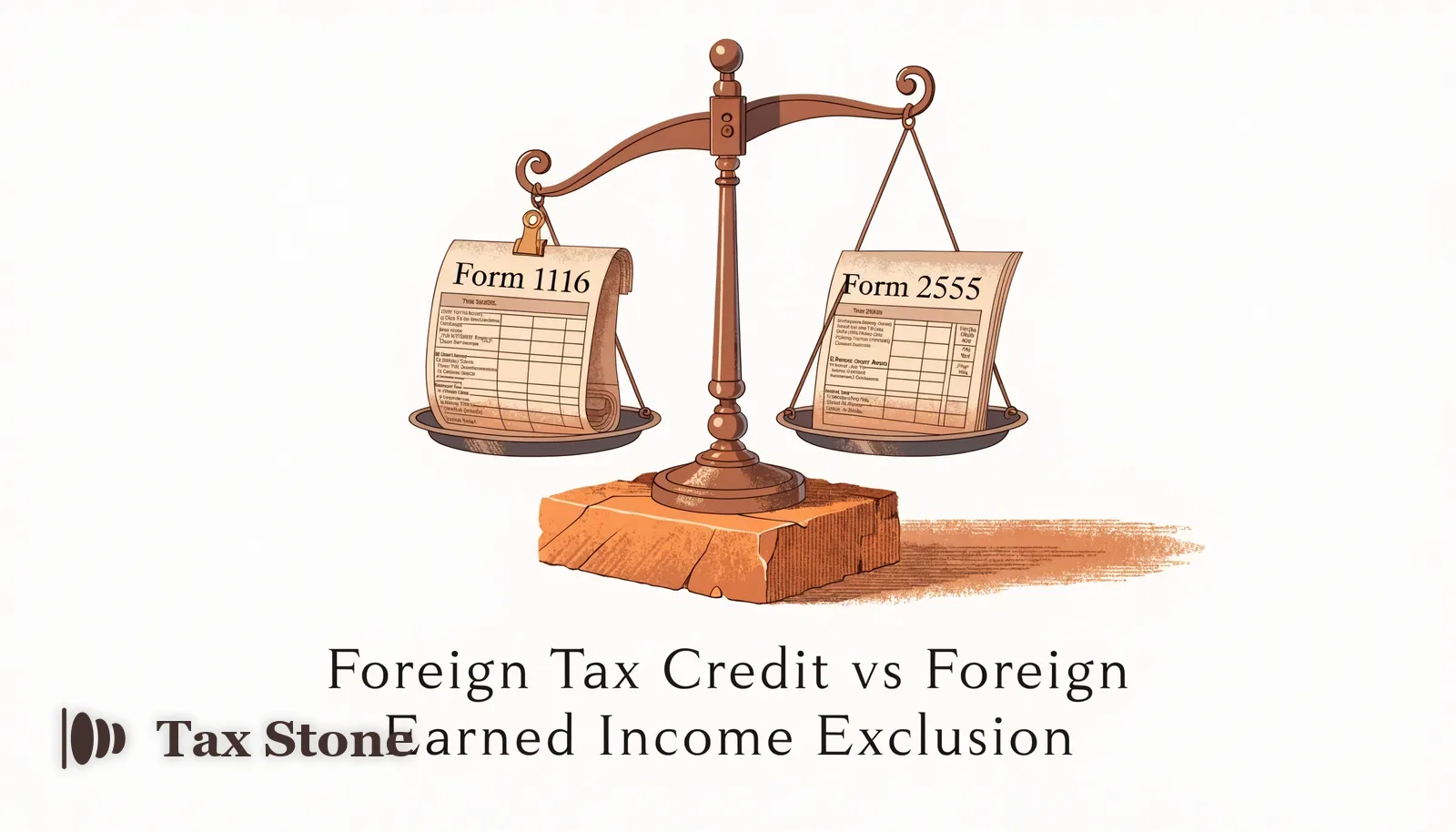
The Foreign Earned Income Exclusion (FEIE) and the Foreign Tax Credit (FTC) are the two main tools that stop Americans abroad being taxed twice — and choosing between them is the most consequential decision on a US expat return. For most Americans living in the UK, the Foreign Tax Credit is the better choice, because UK tax rates are typically higher than US rates and the credit preserves valuable benefits the exclusion forfeits. But not always — and choosing wrong can quietly cost you thousands a year in lost credits and benefits. Here is exactly how each works, why the credit usually wins in the UK, the situations where the exclusion is better, and how to decide for your own numbers.
How the FEIE works
The Foreign Earned Income Exclusion (claimed on Form 2555) lets you simply exclude foreign earned income from US tax — up to $130,000 for the 2025 tax year, rising to $132,900 for 2026, per qualifying person. It removes that income from your US return entirely. It applies only to earned income (salary, wages, self-employment), not to investment income, pensions or rental income, and you must meet the bona fide residence or physical presence test.
How the Foreign Tax Credit works
The Foreign Tax Credit (claimed on Form 1116) takes a different approach: instead of excluding income, it gives you a dollar-for-dollar credit against your US tax for foreign income tax you have already paid. Because the UK generally taxes a UK resident's income before the US does, you can credit that UK tax against your US bill on the same income. Where the UK tax is at least as high as the US tax — which it usually is — the credit wipes out the US liability on that income.
Why the FTC usually wins in the UK
The UK's income-tax rates (20%, 40% and 45%) are generally higher than the equivalent US rates, so the UK tax you pay is usually more than enough to cover the US tax on the same income. That means the Foreign Tax Credit not only eliminates your US bill but can leave you with excess credits to carry forward. Crucially, unlike the FEIE, the FTC does not remove your income from the US system — and that has two big advantages.
- It preserves the refundable Child Tax Credit — worth up to $1,700 per child — which the FEIE disqualifies you from claiming.
- It keeps 'earned income' on your return, so you may still be able to contribute to a US IRA, which excluded income cannot support.
When the FEIE wins
The exclusion is not dead — it is better in specific situations. If your UK tax on the income is low or nil (for example, income below the UK personal allowance, or certain lower-taxed situations), there is little UK tax to credit, so excluding the income with the FEIE can produce a lower US bill than the FTC. It can also be simpler for people with modest, purely-employment income and no children or IRA plans. The point is that the FEIE wins when there isn't enough UK tax to make the credit do the work.
Can you use both?
Yes — carefully. You can use the FEIE on earned income up to the cap and the Foreign Tax Credit on income above the cap or on other income types (like investment income). What you cannot do is claim both on the same dollar of income. Combining them well is an art: you exclude the slice that benefits from exclusion and credit the rest. Done wrong, it wastes credits or loses benefits, which is why this is a modelled decision rather than a default.
The five-year revocation trap
There is a catch with the FEIE that catches people out: once you revoke a FEIE election, you generally cannot claim it again for five years without IRS permission. So switching from the FEIE to the FTC is not always freely reversible. This is one reason the choice deserves proper thought up front — flip-flopping between the two has lasting consequences, and the wrong revocation can lock you out of the exclusion for years.
Carryover credits: a hidden FTC benefit
Because UK rates are higher, many Americans in the UK build up excess Foreign Tax Credits — more UK tax paid than the US tax it can offset. Those excess credits can generally be carried back one year and forward up to ten years, banking relief you can use against future US tax on foreign income. The FEIE produces no such carryover. For anyone whose income or US exposure varies year to year, this stored value is a meaningful long-term advantage of the credit.
How to decide
- Do you have US-citizen children? The FTC preserves the refundable Child Tax Credit; the FEIE usually forfeits it.
- Is your UK tax on the income high? If yes, the FTC likely covers your US bill and banks carryover credits.
- Is your UK tax low or nil? The FEIE may give a lower US bill.
- Do you want to contribute to a US IRA? The FTC keeps the earned income that supports a contribution.
- Are you self-employed? Remember neither removes self-employment tax.
A worked example: a £60,000 London salary
Take an American on a £60,000 salary in London. She pays roughly £11,400 in UK income tax on that salary. Converted to dollars, that UK tax is far more than the US income tax due on the same earnings — so if she uses the Foreign Tax Credit, the credit not only eliminates her US income tax but leaves her with excess credits to carry forward, and she keeps the refundable Child Tax Credit for her children. If instead she used the FEIE, she would exclude the salary, owe no US income tax either — but forfeit the refundable Child Tax Credit and bank no carryover. Same salary, materially different outcome.
Flip the facts to someone with only £10,000 of lightly-taxed income, and the maths reverses: there is little UK tax to credit, so excluding the income with the FEIE gives the cleaner result. The example shows why the answer is always 'it depends on your numbers'.
The foreign housing exclusion angle
One more factor in the comparison: the FEIE comes paired with the foreign housing exclusion, which can exclude certain housing costs above a base amount, with a higher cap in expensive cities like London. For a high-rent Londoner relying on the exclusion, the housing exclusion can add meaningfully to the amount sheltered. The Foreign Tax Credit has no direct equivalent, though it usually does not need one because high UK tax already covers the US bill. It is another reason the two approaches can produce different results for the same person.
What about investment income, pensions and rental?
A crucial limitation: the FEIE only covers earned income — salary, wages and self-employment. It does nothing for UK investment income, pensions or rental profits. The Foreign Tax Credit, by contrast, can be applied against US tax on those passive income types too (using the UK tax paid on them). So for anyone with meaningful UK dividends, interest, pension income or rental, the Foreign Tax Credit is doing work the FEIE simply cannot — often making the credit the backbone of the return even where the FEIE handles part of the salary.
Self-employment: neither one removes SE tax
A vital point for freelancers and business owners: whichever you choose, neither the Foreign Tax Credit nor the FEIE reduces US self-employment tax. That 15.3% Social Security and Medicare charge is a separate tax, removed only by the US/UK Totalization Agreement with a certificate of coverage. So a self-employed American in the UK weighing FTC vs FEIE for income tax must remember the SE-tax question is answered separately — and getting both right is what produces the lowest legal bill.
Common FTC vs FEIE mistakes
- Defaulting to the FEIE and forfeiting the refundable Child Tax Credit every year.
- Using the FEIE and then being unable to contribute to a US IRA (no eligible earned income).
- Revoking the FEIE casually and being locked out of it for five years.
- Wasting Foreign Tax Credits by not carrying excess credits forward.
- Forgetting that the FEIE does nothing for investment income, pensions or rental — only the FTC helps there.
- Assuming either one removes self-employment tax — it does not.
Model it, don't default to it
The biggest mistake is choosing the FEIE by habit because it 'sounds simpler', and quietly handing back the Child Tax Credit and IRA room every year. For most working Americans in the UK the Foreign Tax Credit is the stronger choice, but the only way to be sure is to run your actual numbers both ways. A US tax specialist in the UK can model the two and pick the combination that legally minimises your bill.