Choosing an Advisor
Accountants for US Expats in the UK: ACCA vs EA — Which Do You Need?
ACCA, CPA, Enrolled Agent — the letters matter. Here is what each credential actually means for Americans in the UK, and why most expats need both the US and UK sides covered.
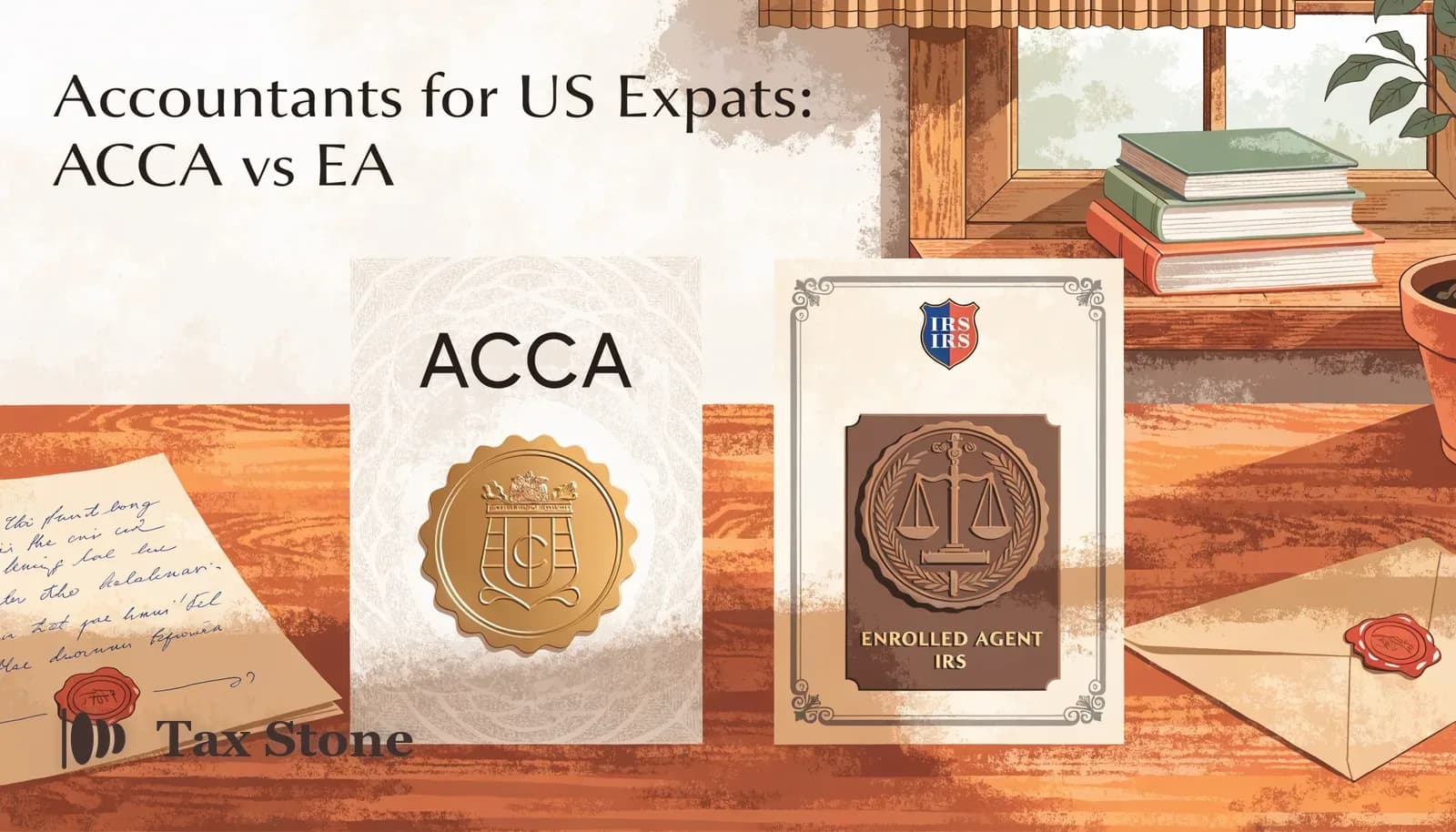
When you search for an accountant as an American in the UK, you meet a wall of letters: ACCA, ACA, CPA, EA. They are not interchangeable, and picking the wrong one is the single most common reason expat tax goes wrong. The short answer: an Enrolled Agent (EA) or US CPA handles your US return, an ACCA- or ACA-qualified accountant handles your UK return, and most Americans in the UK genuinely need both. Here is what each credential means and how to choose.
What an Enrolled Agent (EA) is
An Enrolled Agent is a tax professional licensed directly by the IRS — the highest credential the IRS awards. EAs are tested specifically on US taxation and can represent taxpayers before the IRS on audits, collections and appeals. For an American in the UK, the EA is the core US-side credential: this is the person who should prepare and sign your Form 1040 and handle your FBAR and FATCA filings.
What ACCA (and ACA) mean
ACCA (Association of Chartered Certified Accountants) and ACA (the ICAEW chartered qualification) are UK accounting credentials. An ACCA-qualified accountant understands UK tax — Self Assessment, UK pensions, capital gains, National Insurance — and HMRC's rules. They are the right professional for your UK return, but a UK qualification alone does not make someone competent to prepare a US tax return.
What about a CPA?
A US CPA (Certified Public Accountant) is a state-licensed US accountant. Like an EA, a CPA can prepare US returns and represent clients before the IRS; the difference is mainly the licensing route. For expat purposes, an EA and a CPA are both valid US-side credentials. What matters is that someone with a genuine US credential — EA or CPA — stands behind your 1040.
One practical advantage of an Enrolled Agent for expats is that the EA credential is national and tax-specific: an EA is licensed by the IRS itself rather than a single state, and is tested purely on taxation, including the rules that affect Americans abroad. A CPA's licence is tied to a state and covers a broader range of accounting work. Both can do the job well; for a UK-based American whose only US connection is the federal return and reporting forms, the EA is often the most directly relevant credential.
EA vs ACCA: the simple way to think about it
The danger is hiring only one side. A UK-only accountant may file your Self Assessment perfectly while missing that your ISA is a PFIC for US purposes; a US-only preparer may handle your 1040 but miss UK reliefs.
- EA / US CPA → the US side: Form 1040, FEIE/FTC, FBAR, FATCA, PFICs, IRS representation.
- ACCA / ACA → the UK side: Self Assessment, UK CGT, UK pensions, HMRC dealings.
- Both → the overlap: making the US/UK treaty and Foreign Tax Credit work so you are not taxed twice.
Why most Americans in the UK need both
Because you file with both the IRS and HMRC, the cleanest setup is a firm that holds both credentials — EA/CPA expertise for the US and ACCA/ACA expertise for the UK — working as one team. That way a single adviser sees the whole picture: they time your UK tax payments so they credit correctly against US tax, decide between the Foreign Earned Income Exclusion and the Foreign Tax Credit, and handle FBAR and FATCA without anything falling between the two systems.
Questions to ask before you hire
- Do you hold an IRS Enrolled Agent or US CPA credential, and who signs the 1040?
- Do you also have ACCA/ACA expertise for my UK Self Assessment?
- Will you handle FBAR, Form 8938 and any PFIC reporting on my ISAs and funds?
- How do you decide between the FEIE and the Foreign Tax Credit for me?
- Are your fees fixed and quoted in writing before work begins?
What a dual-qualified engagement looks like
When one firm holds both credentials, the process feels very different from juggling two accountants. A dual-qualified team gathers your information once, then works both returns in tandem: they calculate your UK liability, decide how that UK tax is best used as a Foreign Tax Credit on the US side, choose between the FEIE and the credit, and make sure the same income is reported consistently to both HMRC and the IRS. Nothing falls through the gap because one team owns the whole picture.
Practically, that means a single point of contact, one document request rather than two, and a coordinated timeline that respects both the UK 31 January deadline and the US filing dates. It also means that when a tricky item comes up — a pension lump sum, an ISA, a property sale — someone is looking at both the UK and US consequences at the same time, rather than each accountant solving only their half.
Red flags when choosing an expat accountant
Any one of these is a sign the firm is not a genuine cross-border specialist. The right adviser will raise these issues before you do.
- No US credential (EA or CPA) anywhere in the firm, yet they offer to sign your 1040.
- Treating your ISA or UK funds as simply tax-free, with no mention of PFICs or Form 8621.
- No mention of FBAR or FATCA at all when you describe your UK accounts.
- Vague, open-ended fees with no written quote before work starts.
- Pushing the Foreign Earned Income Exclusion on everyone without weighing the Foreign Tax Credit.
How expat tax fees usually work
Cross-border tax is specialist work, so it is not the cheapest — but it should be transparent. A reputable firm gives you a fixed, written quote based on your specific forms and complexity (number of accounts, whether you hold PFICs, whether any US tax is actually due), rather than an open hourly meter. You should know the cost of your US return, your UK return, and any FBAR or FATCA filings before anyone starts work. If a firm cannot or will not quote up front, treat that as a warning sign.
A typical first-year engagement, step by step
If you have never used a cross-border specialist before, it helps to know what a good first year looks like. It usually begins with a short consultation to understand your situation — when you moved, your income sources, your UK accounts, pensions and investments, and whether you have filed US returns before. From there the firm scopes the work and gives you a written, fixed quote covering both the US and UK sides.
Next comes a single, organised document request rather than two competing ones. The team prepares your UK Self Assessment and your US Form 1040 together, decides the optimal use of the Foreign Tax Credit and the FEIE, completes any FBAR, FATCA and PFIC filings, and reviews everything for consistency across both systems before anything is submitted. You get one explanation of the result — what you owe where, and why — instead of two partial pictures. In later years the process is faster because your position is already mapped.
When you might need more than one specialist
Occasionally even a dual-qualified firm will bring in extra expertise, and a good adviser will tell you when. Complex situations — owning a UK limited company, holding rental property on both sides of the Atlantic, planning to renounce citizenship or surrender a Green Card, or untangling several years of missed filings — can call for specialist input on a particular form or planning question. The point is not that you need a crowd of advisers, but that a strong lead firm coordinates any specialists so you still deal with one team.
Why credentials matter more than price
It can be tempting to choose the cheapest option, or a general high-street accountant who quotes a low fee for "a tax return". For cross-border tax, that is usually a false economy. The cost of getting an expat return wrong is rarely the preparation fee — it is the penalties for a missed FBAR, the punitive US tax on an unreported PFIC, or the years of amended returns needed to undo a mistaken filing position. Each of those can dwarf the difference between a cheap generalist and a properly credentialed specialist.
Credentials are the simplest proxy for whether someone can actually do this work safely. An Enrolled Agent or CPA has been tested and licensed on US tax; an ACCA or ACA accountant on UK tax. When a firm holds both, you are paying for the assurance that the person signing each return is genuinely qualified to do so — and that the two halves of your tax life are being looked at together. In a field where a single overlooked form can cost far more than the engagement itself, that assurance is the value, not an optional extra.
The bottom line
ACCA and EA are not rivals — they are two halves of the same job. For an American in the UK, you want the US side held by an Enrolled Agent or CPA and the UK side by an ACCA/ACA accountant, ideally under one roof so nothing is missed in the gap between two tax authorities. That combination is what turns a confusing, double-filing situation into a single, coordinated process.
Related TaxStone services