Cross-Border · Estate Planning
US Estate Tax vs UK Inheritance Tax: A Cross-Border Estate Planning Guide (2026)
Two death taxes, two sets of rules, and a treaty in between. Here's how the US estate tax and UK inheritance tax compare in 2026 — and how families with a foot in each country stop the same estate being taxed twice.
The US estate tax and the UK inheritance tax are both taxes on wealth passing at death, but they are built on completely different foundations — different thresholds, different rates, and different tests for who is caught. For a family with US and UK connections, the danger is that both systems reach for the same estate at once. The good news is that a dedicated US–UK estate and gift tax treaty exists precisely to referee that overlap. This guide compares the two taxes for 2026 and explains how cross-border planning keeps the total bill sane.
Two taxes, two philosophies
The core difference is who pays. The US estate tax is levied on the estate of the person who died — it is a tax on the deceased's worldwide assets before anything passes to heirs. The UK inheritance tax (IHT) is also charged on the estate, but the UK reaches worldwide assets based on the deceased's residence and (historically) domicile, while charging non-residents only on UK-situated assets.
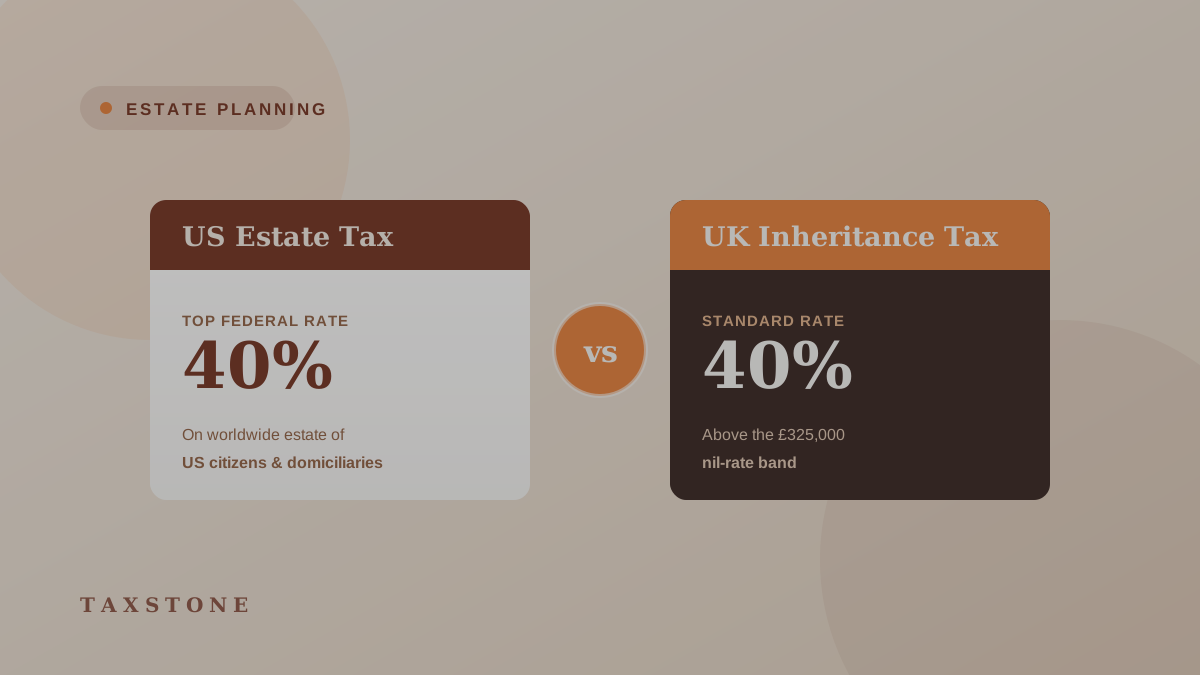
The other headline difference is the numbers. The US estate tax has a very high exemption but a 40% rate above it; the UK has a much lower threshold but also a 40% rate. That combination — high US exemption, low UK threshold — shapes almost every cross-border plan.
US estate tax in 2026: the $15 million exemption
For 2026, the US basic exclusion amount is $15,000,000 per person, following the One, Big, Beautiful Bill (Public Law 119-21) signed into law on 4 July 2025, which made the higher exemption permanent and indexed it going forward. Above that exemption, the top federal estate tax rate is 40%.
A US citizen is taxed on their worldwide estate, but with a $15 million per-person exemption (so $30 million for a married couple using both exemptions and portability), the vast majority of Americans owe no federal estate tax at all. The bigger risk for Americans abroad is usually the UK side.
UK inheritance tax in 2026: the frozen bands
UK inheritance tax works from much lower thresholds. Every individual has a nil-rate band of £325,000, and a residence nil-rate band of up to £175,000 where a qualifying home passes to direct descendants. Both bands are frozen until 5 April 2030. Above the available bands, IHT is charged at 40% (reduced to 36% where at least 10% of the estate is left to charity).
Because the bands are transferable between spouses and civil partners, a married couple leaving a home to their children can combine allowances up to £1,000,000 (£650,000 of nil-rate band plus £350,000 of residence nil-rate band). The residence nil-rate band also tapers away by £1 for every £2 that the estate exceeds £2,000,000, so larger estates lose it entirely.
The exemption gap in one table
- US estate tax exemption (2026): $15,000,000 per person — very high.
- UK IHT nil-rate band: £325,000 per person, plus up to £175,000 residence nil-rate band — much lower.
- Top rate: 40% in both countries (UK 36% with a 10% charity gift).
- Who is caught: US citizens on worldwide assets; UK residents/long-term residents on worldwide assets, others on UK-situated assets only.
- The practical effect: most cross-border families face a UK IHT problem long before a US estate tax problem.
The 2025 UK residence shift changed who is caught
Until recently, UK IHT exposure turned on domicile. From 6 April 2025 the UK moved to a residence-based system: broadly, once you have been UK resident for 10 out of the previous 20 tax years you become a "long-term resident" and your worldwide estate falls within UK IHT, with a tail keeping you in scope for several years after you leave. This is part of the same reform that abolished the non-dom remittance basis.
For an American who settles in the UK long term, this is the key trigger: after a decade of UK residence, US assets that would comfortably sit under the $15 million US exemption can become exposed to UK IHT at 40% above just a few hundred thousand pounds of allowances. That is the double-tax pinch the treaty is there to relieve.
Non-domiciled decedents and the $60,000 trap
The mirror image catches non-Americans with US assets. A person who is not a US citizen or domiciliary is subject to US estate tax on their US-situated assets — such as US real estate and shares in US companies — but receives an exemption equivalent to only $60,000, not $15 million. Above that tiny threshold, US estate tax applies at up to 40%.
So a UK national who dies owning a US holiday home or a large US brokerage account can face a US estate tax bill their family never expected. This is one of the most common cross-border shocks, and it is exactly where the treaty and careful structuring matter most.
The US–UK estate and gift tax treaty
There is a specific US–UK estate, gift and generation-skipping tax treaty — separate from the income tax treaty — that allocates taxing rights and provides relief from double taxation on death. Broadly, it sets rules for which country may tax which assets based on the deceased's situation, and it requires each country to give credit for tax paid to the other so the same asset is not fully taxed twice.
Importantly, the treaty can also give a UK-connected individual access to a more generous US position than the bare $60,000 would suggest, and it provides tie-breaker rules where a person could be treated as belonging to both countries. The mechanics are technical and fact-specific, which is why estate treaty relief is claimed on the US estate tax return with professional support rather than assumed.
The non-citizen spouse problem
In the US, transfers to a surviving spouse are normally free of estate tax under the unlimited marital deduction — but only if the surviving spouse is a US citizen. Where the surviving spouse is not a US citizen (very common in US/UK marriages), that unlimited deduction is not automatically available, and assets passing to them can be taxed on the first death unless a Qualified Domestic Trust (QDOT) is used.
There is a parallel gift-tax rule: lifetime gifts to a non-citizen spouse are limited to an annual exclusion of $194,000 for 2026, rather than being unlimited. Couples in mixed-nationality marriages need to plan around both points. The UK, by contrast, gives spouses and civil partners an unlimited IHT exemption regardless of nationality, though special rules can apply.
Gifting: two very different regimes
- US: you can give $19,000 per recipient per year (2026) free of gift tax, with larger gifts using up your $15 million lifetime exemption; gifts to a non-citizen spouse are capped at $194,000 a year.
- UK: most lifetime gifts are "potentially exempt transfers" that fall out of your estate if you survive seven years, with taper relief on the tax in years three to seven.
- The seven-year rule makes lifetime gifting one of the most powerful UK IHT tools — but it must be genuine and well documented.
- US and UK gift rules do not line up, so a gift that is efficient in one country can be neutral or costly in the other. Model both before you give.
A worked example
Take an American couple who have lived in London for fifteen years and are therefore long-term UK residents. Their worldwide estate is £4,000,000, including a £1,500,000 London home left to their children. For US purposes, £4,000,000 is far below the combined $30 million exemption, so there is no US estate tax.
For UK purposes it is a different story. Their estate exceeds £2,000,000, so the residence nil-rate band tapers away, leaving broadly the two £325,000 nil-rate bands. IHT at 40% then applies to the balance — a bill well into seven figures. The US exemption is irrelevant here; the UK is the binding constraint, and the planning — lifetime gifting, charitable legacies to access the 36% rate, and structuring — all happens on the UK side, coordinated so it does not create a US problem.
Practical cross-border planning moves
- Map situs: know which assets are US-situated, UK-situated, or elsewhere, because situs drives which country can tax them.
- Use both spouses' allowances and consider a QDOT where a surviving spouse is not a US citizen.
- Time UK long-term-resident status: the 10-of-20-years test is now the key UK trigger.
- Coordinate lifetime gifts with the UK seven-year rule and the US annual and lifetime exemptions.
- Claim treaty relief and foreign credits so the same asset is not fully taxed in both countries.
- Review wills in both jurisdictions — a single-country will can misfire badly across a cross-border estate.
The bottom line
For most US/UK families, the US estate tax is a distant concern thanks to the $15 million exemption, while UK inheritance tax — with its £325,000 band, 40% rate and new residence-based reach — is the real and present one. The US–UK estate tax treaty stops the two systems taxing the same assets twice over, but only if you claim it and structure around it deliberately. The estates that go wrong are almost always the ones that planned for one country and forgot the other.
Related TaxStone services