US Tax · NIIT
The Net Investment Income Tax (NIIT): The 3.8% Surtax Americans Abroad Keep Missing
The 3.8% Net Investment Income Tax quietly hits high-earning Americans in the UK — and your Foreign Tax Credits usually can't touch it. Here's who owes it, how it's calculated, and how to plan around it.
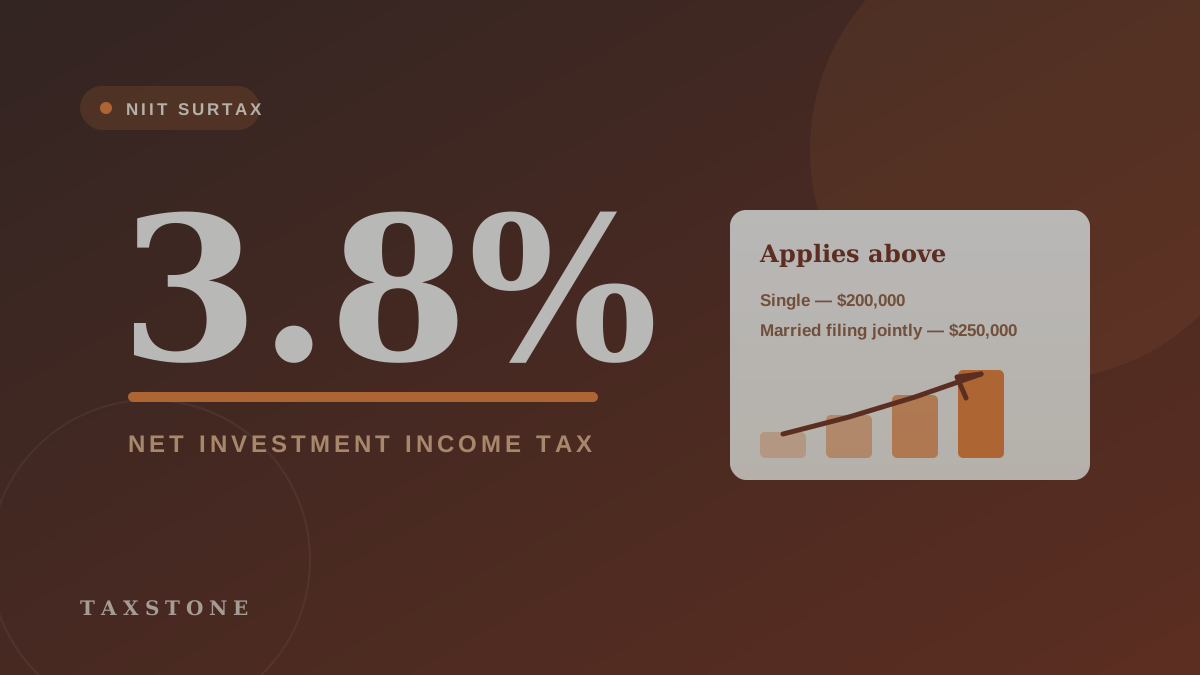
The Net Investment Income Tax (NIIT) is a 3.8% surtax on investment income that applies once your income passes a set threshold — and it is one of the most commonly overlooked taxes for Americans living in the UK. The nasty surprise is not the rate; it is that your Foreign Tax Credits, which usually erase your US bill, generally cannot be used against the NIIT. So even Americans who owe zero regular US income tax after UK credits can still get a NIIT bill. Here is exactly how it works and what you can do about it.
What the NIIT is
The NIIT is an additional 3.8% tax introduced in 2013 to help fund healthcare. It applies to individuals, estates and trusts whose income exceeds certain thresholds and who have net investment income. You report and pay it on Form 8960, filed with your Form 1040.
Crucially, the NIIT sits in a different part of the tax code from regular income tax. That technical detail is the reason it behaves so differently for Americans abroad — and why it catches people out.
The thresholds — and why they never change
The NIIT applies when your modified adjusted gross income (MAGI) exceeds a threshold that depends on your filing status:
- $250,000 — married filing jointly or qualifying surviving spouse.
- $200,000 — single or head of household.
- $125,000 — married filing separately.
Unlike almost every other US tax figure, the NIIT thresholds are not indexed for inflation. They have been $250,000, $200,000 and $125,000 since 2013 and are set to stay there. As wages, portfolios and — importantly — exchange-rate-inflated sterling incomes rise over time, more and more people cross a line that never moves. An American in London earning a good salary with a modest investment portfolio can drift into NIIT territory without any change in their actual wealth.
The married-filing-separately threshold of $125,000 is especially punishing for Americans married to a non-American, who often file separately to keep their spouse out of the US system.
How the NIIT is calculated
The tax is 3.8% of the smaller of two numbers: your net investment income, or the amount by which your MAGI exceeds your threshold. Because it is the lesser of the two, someone just over the threshold with large investment income is capped by the excess-over-threshold figure, while someone far over the threshold with small investment income is capped by their actual investment income.
What counts as net investment income
- Interest, dividends and capital gains (including gains on the sale of shares and, often, a second property).
- Rental and royalty income — including UK rental income.
- Taxable gains on the disposal of investments and certain business interests.
- Non-qualified annuities and passive-activity income.
- Net of allowable investment expenses allocable to that income.
What is NOT net investment income
- Wages and salary — earned income is outside the NIIT (though it counts toward your MAGI).
- Self-employment income subject to self-employment tax.
- Distributions from qualified retirement plans such as 401(k)s and IRAs.
- Tax-exempt municipal bond interest.
- Income from an active trade or business in which you materially participate.
Why your Foreign Tax Credits usually can't help
This is the heart of the problem. The Foreign Tax Credit is designed to offset US income tax under one chapter of the tax code. The NIIT is imposed under a different chapter, and the IRS's position is that foreign tax credits are not available against it. So the UK tax you pay on your dividends, interest and gains can wipe out your regular US income tax on that income — and still leave the 3.8% NIIT sitting there, uncredited.
That is why Americans in the UK regularly find they owe the IRS nothing in regular income tax yet still write a cheque for NIIT. It is a standalone charge that your usual double-tax relief — the Foreign Tax Credit versus the Foreign Earned Income Exclusion — was never built to reach.
Does the US–UK treaty cover the NIIT?
Generally, no. The double-tax relief mechanisms in the US–UK treaty are aimed at income tax, and the prevailing view is that they do not extend a credit against the NIIT for individuals. The result is that the same investment income can effectively be taxed by the UK and then hit again by the 3.8% US surtax, with no clean mechanism to relieve the overlap.
This is one of several places where the treaty's protection is narrower than people assume. It is exactly the kind of gap that makes coordinated US/UK advice worthwhile rather than optional.
A worked example
Consider James, a single American living in London. His MAGI for the year is $260,000, made up of a $210,000 salary and $50,000 of dividends and gains. His single-filer threshold is $200,000, so his MAGI exceeds the threshold by $60,000. His net investment income is $50,000.
The NIIT is 3.8% of the smaller of those two figures — $50,000 — which is $1,900. Even though the high UK tax on James's salary generates Foreign Tax Credits that eliminate his regular US income tax, those credits do not touch the $1,900 NIIT. He owes it to the IRS on top. If his investment income had been larger than his $60,000 excess-over-threshold, the tax would instead have been 3.8% of $60,000.
Planning to reduce the NIIT
- Manage MAGI: because the tax keys off MAGI over a fixed threshold, deferring income or bunching deductions to keep MAGI down in a given year can reduce or avoid it.
- Time capital gains: spreading disposals across tax years, or harvesting losses to offset gains, directly lowers net investment income.
- Use retirement accounts: qualified plan distributions are excluded from net investment income, so the shape of your withdrawals matters.
- Watch filing status: the $125,000 married-filing-separately threshold is low, so the MFS-versus-MFJ decision has NIIT consequences.
- Mind the PFIC overlap: gains and distributions from UK funds can be both PFIC income and net investment income.
How the NIIT interacts with the sale of your UK home
Selling your main UK residence is a classic NIIT trap. The UK generally gives you Private Residence Relief so there is little or no UK tax, but the US taxes the gain above the $250,000 (single) / $500,000 (joint) principal-residence exclusion — and that taxable gain is net investment income. With no UK tax paid and no foreign tax credit available against the NIIT, the 3.8% can apply on top of regular US capital gains tax.
For high-value London property this can be a five-figure surprise; the NIIT is the extra layer many people forget to budget for.
Reporting: Form 8960
You calculate and report the NIIT on Form 8960, which is filed with your Form 1040. It walks through your investment income, the allowable deductions against it, your MAGI, and the 3.8% applied to the lesser figure. For Americans abroad, the currency conversion of foreign investment income and the correct treatment of UK-source items make the form fiddlier than it looks, and errors tend to run in the IRS's favour if left to guesswork.
The bottom line
The NIIT is small in rate but large in surprise. Its thresholds never move, its 3.8% lands on investment income, and the Foreign Tax Credit and treaty that protect the rest of your US return generally cannot reach it. For a high-earning American in the UK, that makes it one of the few places where careful, forward-looking planning — around the timing of gains, the shape of your income, and your filing status — genuinely changes the bill.
Related TaxStone services