UK Tax · FIG Regime
Non-Dom Is Gone: The UK's New Foreign Income & Gains (FIG) Regime Explained (2025/26)
From 6 April 2025 the UK abolished the remittance basis and the concept of domicile. Here is how the new residence-based Foreign Income & Gains regime works, who gets 4 years of 100% relief, and what it means for Americans and other new arrivals in the UK.
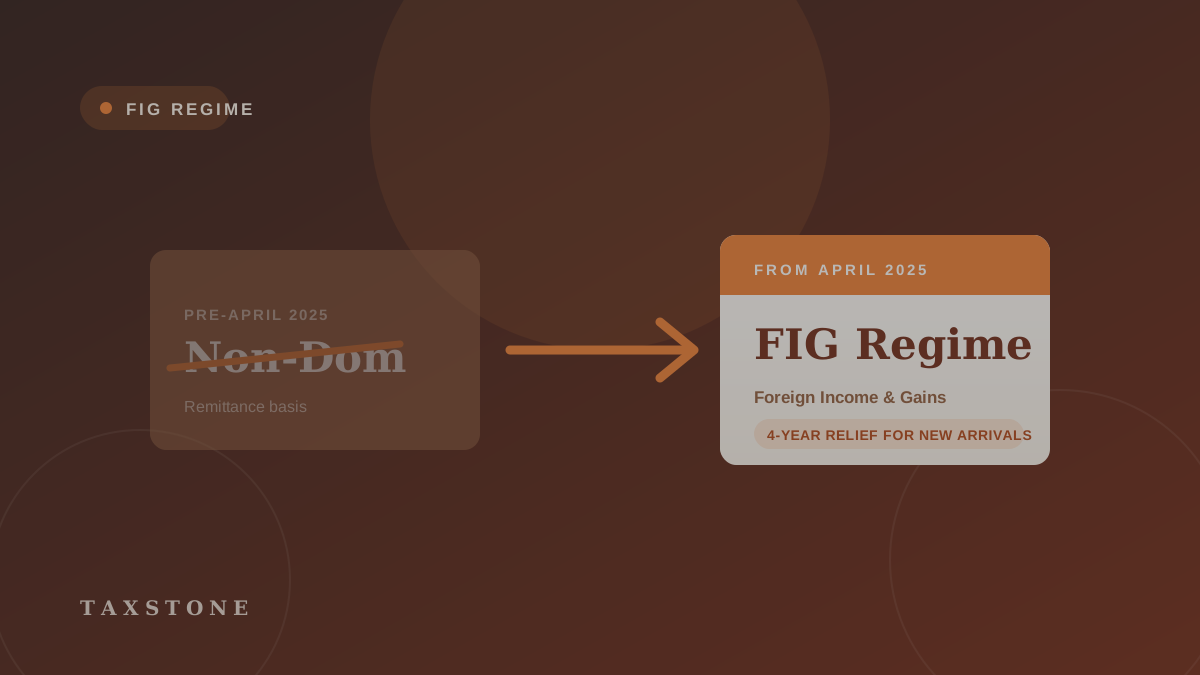
On 6 April 2025 the United Kingdom did something it had not done in over two hundred years: it abolished the remittance basis of taxation and removed domicile as a connecting factor in the tax system. In its place sits a new, residence-based Foreign Income & Gains (FIG) regime that gives qualifying new arrivals 100% relief on their foreign income and gains for their first four years of UK residence. If you have just moved to Britain — or are thinking about it — this is the single most important change to understand, because it decides whether your overseas money is taxed at all.
What actually changed on 6 April 2025
For generations, "non-doms" — UK residents whose permanent home (domicile) was considered to be abroad — could elect the remittance basis, paying UK tax on foreign income and gains only if they brought the money into the UK. That system, and the very concept of domicile for tax, has now gone. From 6 April 2025 the UK taxes you on the basis of where you are resident, not where you are domiciled.
In practical terms, the default for a UK resident is now worldwide taxation: your foreign income and capital gains are taxable in the UK as they arise, whether or not you remit them. The one major exception is the new FIG regime, which switches that default off for the first four years for people who genuinely qualify as new residents.
The FIG regime in one sentence
The Foreign Income & Gains regime lets a "qualifying new resident" claim 100% UK tax relief on chosen foreign income, foreign gains, or both, for up to their first four consecutive tax years of UK residence — provided they were not UK resident in any of the ten tax years immediately before arriving.
Who counts as a qualifying new resident
The eligibility test is deliberately simple compared with the old domicile rules. You are a qualifying new resident for a tax year if both of the following are true:
- The year is one of your first four tax years of UK residence, and
- You were not UK resident in any of the ten consecutive tax years immediately before that first year of residence.
The 10-year clock and returning residents
The ten-year look-back is what makes the regime a genuine "new arrivals" relief rather than a permanent loophole. It applies equally to people who have never lived in the UK and to Britons returning home — a returning UK national who has been non-resident for a full ten tax years can qualify for the FIG regime just like a first-time arrival.
Residence is determined under the Statutory Residence Test, so counting the ten years correctly matters. If you were UK resident in even one of the previous ten tax years, you do not qualify, and your foreign income and gains are taxable on the arising basis from day one. Getting the residence history right before you move is exactly the kind of thing worth checking in advance.
You have to claim it — every year
The FIG regime is not automatic. For each of your four qualifying years you must make a claim on your self-assessment return, and you choose what to claim relief on: your foreign income, your foreign gains, or both. You can claim in some years and not others, which gives you real flexibility — but it also means a missed claim is a missed relief.
There is a trade-off to weigh. In a year you claim the FIG regime, you lose your tax-free personal allowance and your capital gains annual exempt amount. For most people with meaningful foreign income the relief far outweighs those lost allowances, but in a low-foreign-income year it can occasionally be better not to claim. This is a genuine annual optimisation exercise rather than a set-and-forget election.
What the FIG regime covers — and what it doesn't
- Covered: most foreign employment income for work done abroad, foreign self-employment profits, foreign dividends and interest, foreign rental income, and foreign capital gains — where you claim relief on them.
- Not covered: UK-source income and UK gains, which remain fully taxable as normal.
- Not covered by itself: your existing pre-6 April 2025 foreign income and gains that you built up under the old remittance basis — those are dealt with separately by the Temporary Repatriation Facility (below).
- Interacts with pensions and investments in ways that need care — for a US person, a UK ISA or fund is still a US tax problem regardless of UK treatment.
The Temporary Repatriation Facility (TRF)
If you previously used the remittance basis, you will have foreign income and gains that arose before 6 April 2025 and were never taxed because you never brought them into the UK. Under the old rules, remitting that money later would trigger UK tax at full rates. The Temporary Repatriation Facility is a time-limited window that lets former remittance-basis users designate and remit those pre-April-2025 funds at a reduced flat rate, giving people a one-off chance to bring historic offshore money onshore cheaply.
The TRF is separate from the FIG regime — the FIG regime deals with new income arising now; the TRF deals with old income built up before the reform. Anyone with a substantial offshore pool from remittance-basis years should model the TRF carefully, because the window will not last forever.
Inheritance tax also moved to a residence basis
The reform was not only about income and gains. Inheritance tax exposure used to hinge on domicile too; from 6 April 2025 it is based on long-term residence. Broadly, once you have been UK resident for 10 out of the previous 20 tax years you become a "long-term resident" and your worldwide estate falls within UK inheritance tax — with a tail that keeps you in scope for a number of years after you leave.
For internationally mobile families this is a major planning point, because UK inheritance tax is charged at 40% above the available nil-rate bands.
What it means specifically for Americans in the UK
Here is the crucial point that trips people up: the FIG regime is a UK relief, and it does nothing to reduce your US tax. As a US citizen or Green Card holder you are taxed by the IRS on your worldwide income every year regardless of what the UK does, because of the saving clause in the treaty.
So a newly arrived American can genuinely have their foreign income escape UK tax under the FIG regime while that same income remains fully US-taxable. That can be a good outcome — you pay one layer of tax instead of two — but it also flips the usual planning logic. Normally Americans in the UK rely on UK tax paid to generate Foreign Tax Credits that wipe out the US bill. In a FIG year, if you pay no UK tax on that income, there is no UK tax to credit, so the US tax can be left standing. Coordinating the two systems in the four-year FIG window is where a cross-border specialist earns their fee.
A worked example
Take Maya, an American executive who moves to London in the 2025/26 tax year having lived in the US for the previous fifteen years. She has £120,000 of UK salary, plus £40,000 of US dividends and a £30,000 gain on a US brokerage account. She has never been UK resident, so she qualifies for the FIG regime.
For UK purposes, she pays UK tax on her £120,000 UK salary as normal, but claims the FIG regime on her US dividends and gains, so the £40,000 and £30,000 escape UK tax entirely for now. For US purposes, all of it — salary, dividends and gain — is reported to the IRS. Because her UK salary bears high UK tax, her Foreign Tax Credit covers the US tax on the salary; but the US dividends and gain, which paid no UK tax, may generate a residual US liability, including potential exposure to the 3.8% Net Investment Income Tax. The FIG regime saved her UK tax, not US tax — and knowing that in advance lets her plan around it.
Common mistakes with the new regime
- Assuming non-dom "protection" still exists — it does not; the remittance basis is closed.
- Forgetting to claim FIG relief on the self-assessment return, and so being taxed on the arising basis by default.
- Miscounting the 10-year non-residence window under the Statutory Residence Test.
- Overlooking the loss of the personal allowance and CGT annual exempt amount in a FIG-claim year.
- For US persons, claiming FIG relief without modelling the knock-on US tax and Foreign Tax Credit position.
What to do before and after you arrive
Timing your move around the UK tax year (which runs 6 April to 5 April) can extend the practical benefit of the four-year window, and pre-arrival planning — realising gains, restructuring accounts, and documenting your residence history — is far easier before you land than after. Once you are here, the priority is making the right FIG claim each year and keeping clean records of which foreign income and gains you have claimed relief on.
Because the reform is barely a year old, HMRC guidance is still bedding in and the interaction with other countries' tax systems is complex. If you are moving to the UK with international income, or you are an American already here trying to make sense of the new landscape, speak to a specialist who handles both sides.
The bottom line
The abolition of non-dom status is the biggest shake-up of UK personal taxation in a generation. For genuine new arrivals, the FIG regime is generous — four years of tax-free foreign income and gains is a real prize. But it is a claim-based, time-limited relief with a hard 10-year entry test, and for Americans it solves only half the equation. Understand which half, plan the four years deliberately, and coordinate the UK and US positions from the start.